
Tracing Former Buchanan County Property Owners
Several record sets can name former owners. Each covers a different era. The online land-record system does not state its earliest Buchanan County year. The Library of Virginia anchors the offline side. Its microfilm holds county indexes, deed books, land grants, and surveyor books. Begin with the latest deed. Then choose the older source that covers the prior owner's date.
| Source | Years It Covers | Where Held | What It Shows |
|---|---|---|---|
| Virginia COVERS land-record system | Buchanan start year not stated | Remote access for participating localities; verify county coverage | Searchable filed land instruments where available |
| Grantor and grantee conveyance indexes | 1858-1976 | Library of Virginia microfilm finding aid | Historical party indexes to real-estate transfers |
| Buchanan Deed Book A | 1870-1887 | Library of Virginia finding aid / local records | Recorded deed volumes |
| Land grants and surveyors' books | 1788-1920; 1871-1951 | Library of Virginia microfilm listing | Earlier grants and survey references |
The Library of Virginia's Buchanan microfilm finding aid lists the historical reel series behind a former-owner search of Buchanan County property records.
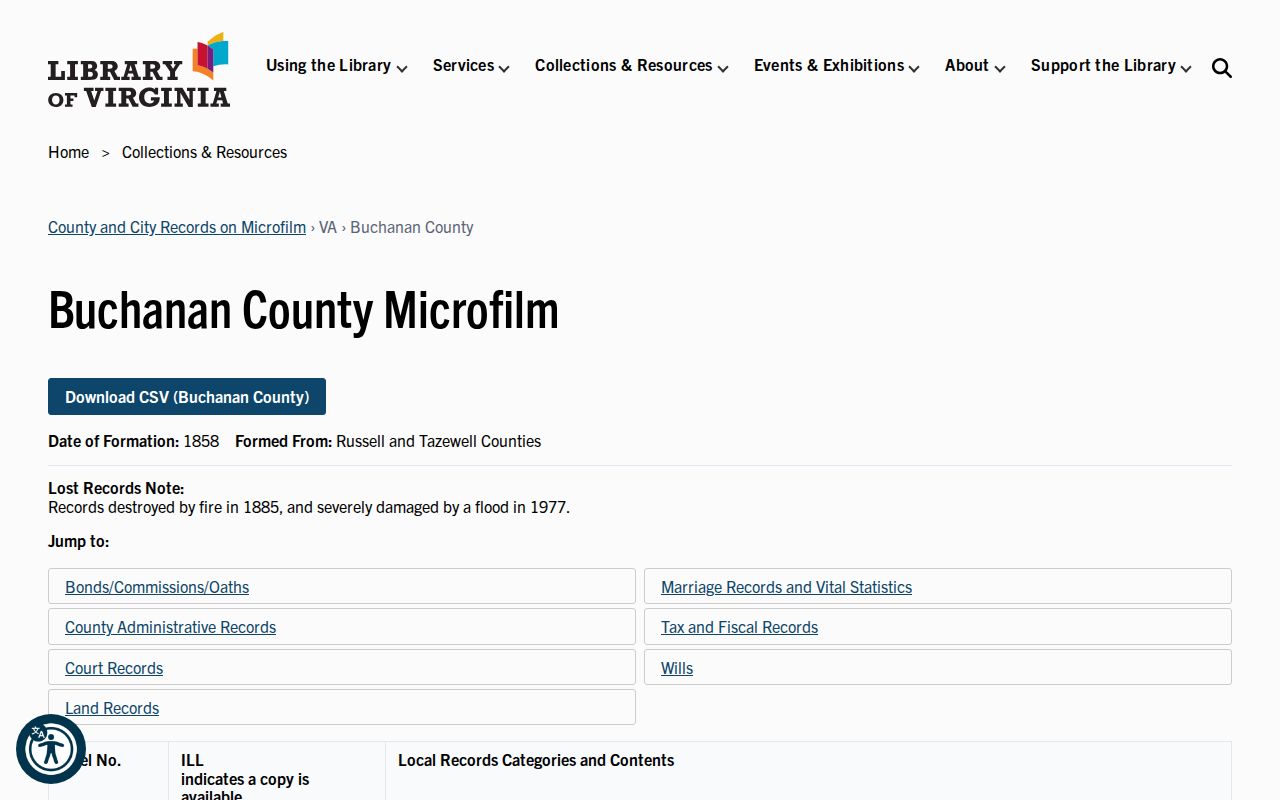
The catalog shows which reels and deed-book series exist. It is a finding aid, not a deed or an owner of record result.
Trace the Buchanan County Chain Backward
Every deed hands you the next search key. A grantee in one deed becomes a grantor later. At each turn, read the legal description and recording date in the Buchanan County deed records. That habit keeps the chain from drifting onto a neighboring parcel that carries a similar family name.
- Find the latest deed and record its grantee, grantor, date, and property description.
- Search the grantor's prior acquisition as a grantee in the earlier transaction.
- Match acreage, creek or road names, adjoining owners, and parcel references at each step.
- At the documented 1858 index start, check older Russell or Tazewell records when needed.
- Grantor
- The party who conveyed an interest in the deed.
- Grantee
- The party who received that interest.
- Chain of title
- The ordered sequence of recorded transfers for a parcel.
- Legal description
- The deed's written land description, which may use acreage, creeks, roads, or adjoining owners.
The Earliest Buchanan County Owner Records
The offline grantor and grantee indexes begin in 1858. That is when Buchanan County was formed from Russell and Tazewell. Deed Book A begins in 1870. The land-grant listing reaches to 1788. Those catalog dates describe the county's historical holdings, not the first year of online access. A blank online result does not mean earlier owners are missing.
Lawful use. Use former-owner records for house history, title research, and property diligence. Do not use an ownership trail to track, threaten, or harass a living person.
Former Owners Before Buchanan County Existed
Buchanan County's 1858 formation cuts a line through older property chains. A tract may sit in Russell or Tazewell records. Its deed may still live in a parent county. So work back to the earliest Buchanan deed first. Copy its legal description and the adjoining owners named in it. Those clues open the Russell and Tazewell deed indexes. The Library of Virginia lists land grants to 1788 for all three counties. A grant is not the same as every later deed. Yet it can anchor an earlier record path for the tract. Names and boundaries shift as land was divided. So compare the acreage and watercourse calls instead of a modern street address.
Estate Transfers in Buchanan County Deed History
Death reshapes a clean grantor-to-grantee line. The Buchanan Circuit Court Clerk holds the papers that explain it: wills, heir lists, fiduciary records, probate files, and land instruments. A later deed may carry an executor's signature. Several heirs may sign together. Some transfers happen under a court decree. One owner's name may yield no simple purchase deed. Search the land index for the decedent, the estate, the executor, and each heir, then read the matching probate record. The official Buchanan Circuit Court Clerk page gives the courthouse contact. A death certificate is a separate vital record with access limits, so a probate filing is often the more direct source for the property transfer.
Buchanan County's Courthouse Fire and Old Records
The historic courthouse nomination records a hard chapter. The 1906 building's interior was gutted by fire in 1915 and rebuilt in 1917. That history matters when an old deed image or replacement volume looks out of place. Still, it does not prove any deed book burned. Blame no index gap on the fire without proof. Ask the Clerk or the Library of Virginia whether a given chain rests on an original volume, a replacement, or microfilm. The finding aid lists exact index years and book series. A former-owner search can then cite its source instead of repeating a lost-records legend.
Buchanan County Creek and Ridge Clues
Old Buchanan County deeds rarely name a modern address. A creek, branch, ridge, hollow, road, acreage figure, or adjoining owner did that work instead. Record each name as a search key. Roads get renamed. Indexes misspell family names. Even so, a tract reveals itself through its land description and the parcels beside it. Use recorded plats and the surveyors' books when a boundary call is hard to place. The finding aid lists surveyors' books for 1871 through 1951. A survey can tie an old metes-and-bounds description to a later road or subdivision, though a tax map alone will not prove the exact line.
Buchanan County Library Leads for Past Owners
The Buchanan County Public Library's digital archive holds thousands of scanned pages. Its collections include the Virginia Mountaineer, Grundy and Hurley yearbooks, photographs, and other local material. The online newspaper runs from 1961 through 2014 in its indexed collections, and the physical library reports later issues plus Bristol Herald Courier microfilm. A newspaper item can surface a former business, road, school, mine, or surname variant that unlocks a deed index entry.
The Buchanan digital archive supplies the historical leads. Confirm any land transfer with the Clerk's instrument once a name or date surfaces. A newspaper clipping is not proof of title. The current owner entry is a different question from the chain of past owners, so see the Buchanan County current owner record card notes.
Keep the chain ordered with dates and party roles. For every deed, record who conveyed and who received. Note the execution date, the recording date, the book and page or instrument number, and the legal description. A deed can be signed on one date and recorded much later. Taxes use the January 1 owner of record, so the tax roll can lag behind a transfer. When a property card and a deed show different names, compare those dates before concluding that an index entry is missing.
The Library of Virginia's Buchanan collection offers a practical starting point for older names. Its grantor and grantee conveyance indexes cover 1858 through 1976. Deed Book A is listed from 1870 through 1887. The county itself began in 1858, formed from Russell and Tazewell, so any chain older than that boundary continues in a parent county. Land-grant records and surveyors' books add context to the original tract, but each later conveyance that divided or transferred it still needs its own deed.
Buchanan's courthouse was rebuilt after the 1915 fire, though no specific deed series is identified in the county's history as destroyed. Ask the Clerk which index and volume cover a gap. Never assume a missing search result means the instrument vanished. Where a microfilm index points to a volume, confirm the page image and legal description. The same surname may appear in unrelated deeds across the county.
The LVA reference is a finding aid, not a promise that each cited item exists as a complete online deed image. It points researchers to Buchanan's grantor and grantee indexes, the early deed book, land grants, and surveyors' books. Use the collection dates to pick a next step. Then ask whether the Clerk's office, the Library of Virginia, or a microfilm reader can supply the particular index or book image the chain requires.